Showing posts with label gastrointestinal symptoms. Show all posts

Wednesday, January 20, 2021

Irritable Bowel and COVID-19

The first symptoms of Coronavirus disease  (day 0) begin from two to 14 days after exposure to the virus (marked as day –5 in the figure below, since median time is about five days). The disease affects
different people in different ways. A recent article identified 6 distinct types of COVID-19 with different symptoms,  some of which are hallmarks of the most severe forms of the disease. SARS-CoV-2-infected patients usually first experience a fever. The fever is often followed by a dry cough or fatigue and muscle pain, followed by GI tract symptoms, if they ever occur. Some people, experience nausea or have diarrhea in the days just before the fever begins. 

Gastrointestinal symptoms are reported in about one third of COVID-19 cases, the most common is loss of appetite  - it can happen even in the mildest form of the disease. Nausea/vomiting and diarrhea are slightly less common. Abdominal pain is even less widely known in COVID-19, yet it is  - along with shortness of breath and confusion - is a potential sign of the most severe form of COVID-19. In children, having gastrointestinal symptoms was more frequently associated with severe and critical phenotype (Giacomet et al, 2020). Hyperinflammatory syndrome was presenting with both cardiac and significant GI symptoms (diarrhea, vomit, abdominal pain).

Some researchers suggest that gut dysfunction may exacerbate the severity of infection by enabling the virus to access the surface of the digestive tract and internal organs. These organs are vulnerable to infection because they have widespread ACE2—a protein target of SARS-CoV-2 for its possible routes of entry —on the surface.  ACE2 is abundantly present in the epithelia of the lung and small intestine.
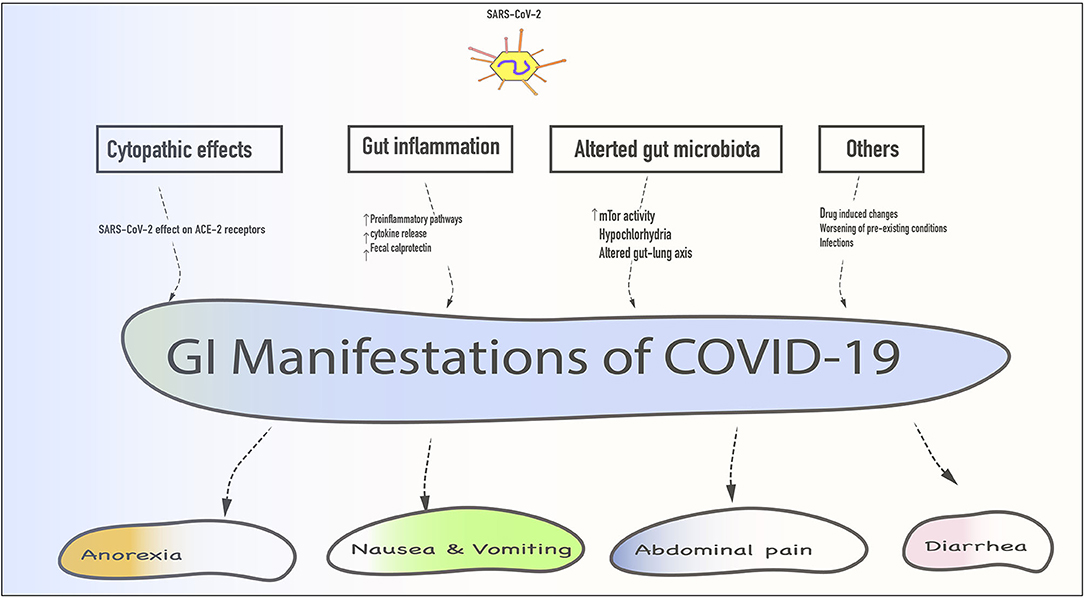
Yet, even if SARS-CoV-2 reaches the GI tract, it may not cause GI problems. An inflamed leaky gut, however, may be associated with a higher risk of severe illness and the microbial imbalance of the gut affecting gut barrier integrity can allow pathogens and pathobionts easier access to cells in the intestinal lining.

Several studies have already demonstrated that, when compared with healthy individuals, COVID-19 patients present a significantly reduced bacterial diversity and higher abundancy of opportunistic Streptococcus, Rothia, Veilonella, and Actinomyces compared to depleted levels of beneficial Agathobacter, Fusicatenibacter, Roseburia, and Ruminococcaceae UCG-013. Rothia was preeviously thought to contribute to the pathogenesis of pneumonia. Critically ill patients on mechanical ventilation who were given probiotics experienced decrease in viral colonization when compared with placebo. However, the efficacy of probiotics use in COVID-19 patients and other bowel remedies remains to be proved.


REFERENES

La Marca A, Capuzzo M, Paglia T, Roli L, Trenti T, Nelson SM. Testing for SARS-CoV-2 (COVID-19): a systematic review and clinical guide to molecular and serological in-vitro diagnostic assays. Reproductive biomedicine online. 2020 Jun 14.

Oshima T, Siah KT, Yoshimoto T, Miura K, Tomita T, Fukui H, Miwa H. Impacts of the COVID‐19 pandemic on functional dyspepsia and irritable bowel syndrome: A population‐based survey. Journal of gastroenterology and hepatology. 2020 Nov 16.

Sudre CH, Lee KA, Lochlainn MN, Varsavsky T, Murray B, Graham MS, Menni C, Modat M, Bowyer RC, Nguyen LH, Drew DA. Symptom clusters in Covid19: A potential clinical prediction tool from the COVID Symptom study app. MedRxiv. 2020 Jan 1.

Riphagen S, Gomez X, Gonzalez-Martinez C, et al. Hyperinflammatory shock in children during COVID-19 pandemic. Lancet. 2020;395:1607–1608.

Giacomet V, Barcellini L, Stracuzzi M, Longoni E, Folgori L, Leone A, Zuccotti GV. Gastrointestinal Symptoms in Severe COVID-19 Children. The Pediatric infectious disease journal. 2020 Aug 10;39(10):e317-20.

Cholankeril G, Podboy A, Aivaliotis VI, Tarlow B, Pham EA, Spencer SP, Kim D, Hsing A, Ahmed A. High Prevalence of Concurrent Gastrointestinal Manifestations in Patients With Severe Acute Respiratory Syndrome Coronavirus 2: Early Experience From California. Gastroenterology. 2020 Aug 1;159(2):775-7.

Gu, S.; Chen, Y.; Wu, Z.; Chen, Y.; Gao, H.; Lv, L.; Guo, F.; Zhang, X.; Luo, R.; Huang, C.; et al. Alterations of the Gut Microbiota in Patients with COVID-19 or H1N1 Influenza. Clin. Infect. Dis. 2020, 71, 2669–2678.

Dhar, D.; Mohanty, A. Gut microbiota and Covid-19- possible link and implications. Virus Res. 2020, 285, 198018. 

Sudre CH, Lee KA, Lochlainn MN, Varsavsky T, Murray B, Graham MS, Menni C, Modat M, Bowyer RC, Nguyen LH, Drew DA. Symptom clusters in Covid19: A potential clinical prediction tool from the COVID Symptom study app. MedRxiv. 2020, June 16. 


Ferreira, C.; Viana, S.D.; Reis, F. Is Gut Microbiota Dysbiosis a Predictor of Increased Susceptibility to Poor Outcome of COVID-19 Patients? An Update. Microorganisms 2021, 9, 53.

Monday, May 30, 2011

Tryptophan in food: Will it make you happy, sleepy or smelly?

And the answer is ... either or all of the above. And this is not a complete list of all that can happen. In some rare conditions, for example, tryptophan could also make your pee purple.


Tryptophan supplements were used as a popular sleeping aid until
negative press in 1989. The FDA banned dietary tryptophan supplements from the market, just days before the arrival of Prozac rising as the new promise for chemical happiness. Further investigation showed that ill effects of tryptophan were actually due to a contaminant in the supplement not the amino acid itself.
Today you can find tryptophan at many supplement retailers. You can also get it from food - from chocolate or red meat, for example. What does it really do in our bodies?

Tryptophan is a complex aromatic amino acid  - one of eight "essential" amino acids that have to be taken with food as they cannot be created by the human body. Tryptophan metabolism is complex - KEGG pathway shows the multitude of reactions it participates in.
One of tryptophan metabolites - Kynurenic acid - is involved in the regulatory function of the gastrointestinal system and the modulation of the inflammatory response. Another metabolite is neurotransmitter Serotonin which has a calming and sleeping-inducing effect on the brain.
L-Tryptophan administration (2 g) as a single dose before a meal has been found to decrease subjective hunger ratings, food intake, and alertness in men (Hrboticky et al., 1985), but not women (Leiter et al., 1987).  Babies  were also found to get sleepier (20 mg supplementation, Yogman and Zeisel, 1983, 1985). Tryptophan can be used by the body to create 5-hydroxytryptophan (also known as 5-HTP and oxitriptan). 5-HTP is sold as a dietary supplement as an antidepressant and sleep aid. It is marketed under many different trade names such as Cincofarm, Levothym, Oxyfan and Triptum.  Studies showed that 5-HTP provides benefits with regard to depression, blood pressure and regular sleep patterns. So even though that fact that the Thanksgiving turkey is responsible for sleepiness is an urban legend, tryptophan could definitely contribute to calmness and happiness.

Yet, according to a study by British researchers, irritable bowel syndrome sufferers have an increase in gastrointestinal symptoms after ingestion of a large dose of tryptophan, in addition to having fewer symptoms of anxiety and depression. One of the reasons: tryptophan metabolism mostly happening along the kynurenine and not 5-HT pathway. Increased tryptophan catabolism was recently shown to be associated with depression, reduced motivation and pessimism in the elderly. According to earlier studies (like the referenced 1998 articles by Austrian scientists), people with fructose malabsorption have abnormal tryptophan metabolism too, leaving them with less available tryptophan, and it seems to be responsible for mental depression (Ledochowski et al., 1998).   Overdose of tryptophan  in healthy adults (5 g in a double-blind, placebo-controlled study) induced  severe nausea and headache and increased drowsiness soon after ingestion (Greenwood et al., 1975). 
What happens to tryptophan abnormally accumulated in intestines? Here come more bad news - it is utilized by intestinal bacteria (e.g. Lactobacillus) and converted into indole and skatole - metabolites responsible for strong fecal smell. The rate of production of these smelly compounds depends on the acidity  - it is greatest at pH 6.5 and less at pH 5.0 and 8.0. Food-food interaction could lessen or enhance the "smelly"effects. The suppression of tryptophan degradation by propolis, for example,  could contribute to beneficial health properties. Preliminary results were also reported for cocoa extracts, Fructooligosacharides (FOS) and resistant starch, but more studies are needed.

So, how much tryptophan do you really need?  Half a gram, 2 grams, even more? It depends on your metabolism, your life style and your diet. It may be a good idea to watch your wellbeing along with tryptophan intake, to find your own optimal daily value.
This post was chosen as an Editor's Selection for ResearchBlogging.org


REFERENCES

Capuron L, Schroecksnadel S, Féart C, Aubert A, Higueret D, Barberger-Gateau P, Layé S, & Fuchs D (2011). Chronic Low-Grade Inflammation in Elderly Persons Is Associated with Altered Tryptophan and Tyrosine Metabolism: Role in Neuropsychiatric Symptoms. Biological psychiatry PMID: 21277567

Christmas DM; Badawy AAB; Hince D; Davies SJC; Probert C; Creed T; Smithson J; Afzal M; et al. (Oct 2010). Increased serum free tryptophan in patients with diarrhea-predominant irritable bowel syndrome. NUTR RES. 30:678-688. DOI.

Hood SD; Hince DA; Davies SJC; Argyropoulos S; Robinson H; Potokar J; Nutt DJ. (Feb 2010). Effects of acute tryptophan depletion in serotonin reuptake inhibitor-remitted patients with generalized anxiety disorder. PSYCHOPHARMACOLOGY. 208:223-232. DOI.

Shufflebotham J; Hood S; Hendry J; Hince DA; Morris K; Nutt D; Probert C; Potokar J. (Nov 2006). Acute tryptophan depletion alters gastrointestinal and anxiety symptoms in irritable bowel syndrome. Am J Gastroenterol. 101:2582-2587. DOI.

Ledochowski M, Widner B, Murr C, Sperner-Unterweger B, Fuchs D. Fructose malabsorption is associated with decreased plasma tryptophan. Scand J Gastroenterol. 2001 Apr;36(4):367-71.

Ledochowski M, Sperner-Unterweger B, Widner B, Fuchs D. Fructose malabsorption is associated with early signs of mental depression. Eur J Med Res. 1998 Jun 17;3(6):295-8.

Xu ZR, Hu CH, Wang MQ. Effects of fructooligosaccharide on conversion of L-tryptophan to skatole and indole by mixed populations of pig fecal bacteria. J Gen Appl Microbiol. 2002 Apr;48(2):83-90.

Jones HE, Johnson RE, Bigelow GE, Silverman K, Mudric T, Strain EC. Safety and efficacy of L-tryptophan and behavioral incentives for treatment of cocaine dependence: a randomized clinical trial. Am J Addict. 2004 Oct-Dec;13(5):421-37. 

Jensen MT, Cox RP, Jensen BB. 3- Methylindole (skatole) and indole production by mixed population of pig fecal bacteria.  Appl Environ Microbiol. 1995 Aug;61(8):3180-4.


Celenza JL. Metabolism of tyrosine and tryptophan - new genes for old pathways. Curr Opin Plant Biol. 2001 Jun;4(3):234-40.