Showing posts with label irritable bowel. Show all posts

Saturday, December 24, 2022

Post-COVID Irritable Bowel Syndrome

Irritable bowel syndrome (IBS) is a common gastrointestinal disorder that affects 9-23% of the global population. While the exact cause of IBS is unknown, it is believed to be a combination of genetic, environmental, and psychological factors. One potential trigger of IBS is infectious illness. Studies have shown that between 3% and 36% of enteric infections can lead to the development of new IBS symptoms, with post-viral IBS being more transient than post-bacterial or post-protozoal IBS. Meta-analysis of published literature found that the incidence of new IBS 12 months after infection was 10.1% (95% confidence interval (CI) 7.2–14.1). The incidence appears higher after parasitic or protozoan infections at 49% compared to 13.8% after bacterial gastroenteritis.

The COVID-19 pandemic has highlighted the potential link between infections and IBS, as many patients with COVID-19 have developed gastrointestinal symptoms, including diarrhea, nausea, vomiting, and abdominal discomfort. In fact, infection of the GI tract is thought to trigger symptoms in approximately 15% of COVID-19 patients. Post-COVID-vaccination gastrointestinal occurrences were reported in 10–20% of cases and the risk of a disease flare in IBS and IBD patients was close to 10%. 

Persistent symptoms after SARS-COV-2 infection, known as Post-acute Sequelae of COVID-19 (PASC) or long-COVID, may occur in anywhere from 10-55% of those who have had COVID-19, New study found that the most common new diagnoses caused by Long Covid were tachycardia, followed by Postural Orthostatic Tachycardia Syndrome (POTS), Myalgic Encephalomyelitis/Chronic Fatigue Syndrome and IBS.

This chart shows the 0roportion of individuals diagnosed with various conditions by severity of mobility disability. Red are cardiopulmonary diagnoses (AF - atrial fibrillation, Blood Clot, Cardiomyopathy, Pericarditis, PE – pulmonary embolism, POTS – postural orthostatic tachycardia syndrome, Myocarditis, Tachycardia), light green are gastrointestinal (Irritable Bowel Disease, Irritable Bowel Syndrome), blue-green are neurologic diagnoses (MS – multiple sclerosis, ME – myaligic encephalomyelitis/chronic fatigue syndrome, PN – peripheral neuropathy, Stroke), and dark green are metabolic/renal diagnoses (AKD - acute kidney disease, Hyperthyroid, Hypothyroid, Type 1 Diabetes, Type 2 Diabetes). A little over 3% of IBS sufferers do not feel disabled, while over 10% are severely disabled.  

There are several risk factors for the development of PI-IBS, including female gender, previous antibiotic treatment, anxiety, depression, somatization, neuroticism, and clinical indicators of intestinal inflammation. A history of Clostridioides difficile infection (CDI) may also increase the risk of PI-IBS by up to 25%. Underlying possible mechanisms include ongoing increased permeability, abnormal serotonin metabolism, and ongoing chronic immune activation together with altered microbiota. 

REFERENCES

Chan WW, Grover M. The COVID-19 Pandemic and Postinfection Irritable Bowel Syndrome: What Lies Ahead for Gastroenterologists. Clinical Gastroenterology and Hepatology. 2022 Aug 6. 

Gabashvili IS. The Incidence and Effect of Adverse Events Due to COVID-19 Vaccines on Breakthrough Infections: Decentralized Observational Study with Underrepresented Groups. JMIR Formative Research. 2022 Nov 4;6(11):e41914. doi: 10.2196/41914. PMID: 36309347; PMCID: PMC9640199.

Ghoshal UC. Postinfection irritable bowel syndrome. Gut and Liver. 2022 May 5;16(3):331.

Lau B, Wentz E, Ni Z, Yenokyan K, Coggiano C, Mehta SH, Duggal P. Physical and mental health disability associated with long-COVID: Baseline results from a US nationwide cohort. medRxiv. 2022 Dec. 7

Lau B, Wentz E, Ni Z, Yenokyan K, Coggiano C, Mehta SH, Duggal P. Physical and mental health disability associated with long-COVID: Baseline results from a US nationwide cohort. medRxiv. 2022 Jan 1.

Nazarewska A, Lewandowski K, Kaniewska M, RosoĊ‚owski M, Marlicz W, Rydzewska G. Irritable bowel syndrome following COVID-19: underestimated consequence of infection with SARS-CoV-2. Polish archives of internal medicine.:16323.

Spiller R, Garsed K. Postinfectious irritable bowel syndrome. Gastroenterology. 2009 May 1;136(6):1979-88.

Thabane M, Marshall JK. Post-infectious irritable bowel syndrome. World journal of gastroenterology: WJG. 2009 Aug 8;15(29):3591.


Wednesday, January 20, 2021

Irritable Bowel and COVID-19

The first symptoms of Coronavirus disease  (day 0) begin from two to 14 days after exposure to the virus (marked as day –5 in the figure below, since median time is about five days). The disease affects
different people in different ways. A recent article identified 6 distinct types of COVID-19 with different symptoms,  some of which are hallmarks of the most severe forms of the disease. SARS-CoV-2-infected patients usually first experience a fever. The fever is often followed by a dry cough or fatigue and muscle pain, followed by GI tract symptoms, if they ever occur. Some people, experience nausea or have diarrhea in the days just before the fever begins. 

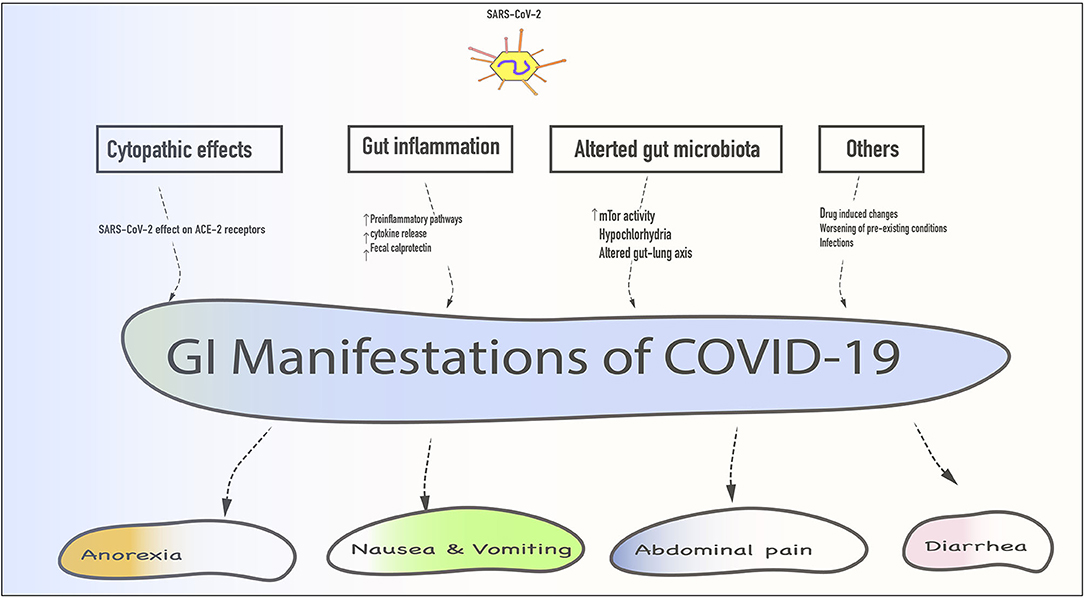
Gastrointestinal symptoms are reported in about one third of COVID-19 cases, the most common is loss of appetite  - it can happen even in the mildest form of the disease. Nausea/vomiting and diarrhea are slightly less common. Abdominal pain is even less widely known in COVID-19, yet it is  - along with shortness of breath and confusion - is a potential sign of the most severe form of COVID-19. In children, having gastrointestinal symptoms was more frequently associated with severe and critical phenotype (Giacomet et al, 2020). Hyperinflammatory syndrome was presenting with both cardiac and significant GI symptoms (diarrhea, vomit, abdominal pain).

Some researchers suggest that gut dysfunction may exacerbate the severity of infection by enabling the virus to access the surface of the digestive tract and internal organs. These organs are vulnerable to infection because they have widespread ACE2—a protein target of SARS-CoV-2 for its possible routes of entry —on the surface.  ACE2 is abundantly present in the epithelia of the lung and small intestine.

Yet, even if SARS-CoV-2 reaches the GI tract, it may not cause GI problems. An inflamed leaky gut, however, may be associated with a higher risk of severe illness and the microbial imbalance of the gut affecting gut barrier integrity can allow pathogens and pathobionts easier access to cells in the intestinal lining.

Several studies have already demonstrated that, when compared with healthy individuals, COVID-19 patients present a significantly reduced bacterial diversity and higher abundancy of opportunistic Streptococcus, Rothia, Veilonella, and Actinomyces compared to depleted levels of beneficial Agathobacter, Fusicatenibacter, Roseburia, and Ruminococcaceae UCG-013. Rothia was preeviously thought to contribute to the pathogenesis of pneumonia. Critically ill patients on mechanical ventilation who were given probiotics experienced decrease in viral colonization when compared with placebo. However, the efficacy of probiotics use in COVID-19 patients and other bowel remedies remains to be proved.


REFERENES

La Marca A, Capuzzo M, Paglia T, Roli L, Trenti T, Nelson SM. Testing for SARS-CoV-2 (COVID-19): a systematic review and clinical guide to molecular and serological in-vitro diagnostic assays. Reproductive biomedicine online. 2020 Jun 14.

Oshima T, Siah KT, Yoshimoto T, Miura K, Tomita T, Fukui H, Miwa H. Impacts of the COVID‐19 pandemic on functional dyspepsia and irritable bowel syndrome: A population‐based survey. Journal of gastroenterology and hepatology. 2020 Nov 16.

Sudre CH, Lee KA, Lochlainn MN, Varsavsky T, Murray B, Graham MS, Menni C, Modat M, Bowyer RC, Nguyen LH, Drew DA. Symptom clusters in Covid19: A potential clinical prediction tool from the COVID Symptom study app. MedRxiv. 2020 Jan 1.

Riphagen S, Gomez X, Gonzalez-Martinez C, et al. Hyperinflammatory shock in children during COVID-19 pandemic. Lancet. 2020;395:1607–1608.

Giacomet V, Barcellini L, Stracuzzi M, Longoni E, Folgori L, Leone A, Zuccotti GV. Gastrointestinal Symptoms in Severe COVID-19 Children. The Pediatric infectious disease journal. 2020 Aug 10;39(10):e317-20.

Cholankeril G, Podboy A, Aivaliotis VI, Tarlow B, Pham EA, Spencer SP, Kim D, Hsing A, Ahmed A. High Prevalence of Concurrent Gastrointestinal Manifestations in Patients With Severe Acute Respiratory Syndrome Coronavirus 2: Early Experience From California. Gastroenterology. 2020 Aug 1;159(2):775-7.

Gu, S.; Chen, Y.; Wu, Z.; Chen, Y.; Gao, H.; Lv, L.; Guo, F.; Zhang, X.; Luo, R.; Huang, C.; et al. Alterations of the Gut Microbiota in Patients with COVID-19 or H1N1 Influenza. Clin. Infect. Dis. 2020, 71, 2669–2678.

Dhar, D.; Mohanty, A. Gut microbiota and Covid-19- possible link and implications. Virus Res. 2020, 285, 198018. 

Sudre CH, Lee KA, Lochlainn MN, Varsavsky T, Murray B, Graham MS, Menni C, Modat M, Bowyer RC, Nguyen LH, Drew DA. Symptom clusters in Covid19: A potential clinical prediction tool from the COVID Symptom study app. MedRxiv. 2020, June 16. 


Ferreira, C.; Viana, S.D.; Reis, F. Is Gut Microbiota Dysbiosis a Predictor of Increased Susceptibility to Poor Outcome of COVID-19 Patients? An Update. Microorganisms 2021, 9, 53.