Showing posts with label body odor. Show all posts

Wednesday, November 30, 2022

The Health Benefits of Mung Beans: Antidiabetic, Anti-inflammatory, and More

Mung beans, also known as green gram or moong, are a type of small, green legume that are native to India and have been cultivated for thousands of years. They are a staple food in many Asian cuisines and are commonly used in traditional medicine, particularly in Ayurveda. 
Mung beans are a good source of nutrients, including protein, fiber, vitamins, and minerals. They are low in calories and fat, making them a healthy choice for people who are trying to lose weight or maintain a healthy weight. Mung beans are also much easier to digest than other legumes such as lentils and hard beans, which include pintos, black beans, and chickpeas. It is worth noting that mung beans are considered to be low FODMAP, meaning that they are generally well tolerated by people with irritable bowel syndrome (IBS) and other digestive disorders. 

One of the key health benefits of mung beans is their ability to cleanse and detoxify the body. Mung beans contain both soluble and insoluble fibers, which help to cleanse the colon and remove toxins from the body. The pasty texture of mung beans is often cited as an indicator of their cleansing properties. 

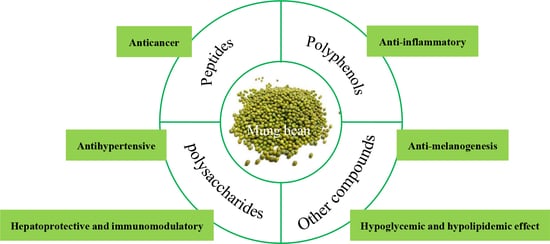
Mung beans have also been shown to have cholesterol-lowering and liver-protective effects, due to the presence of antioxidant compounds such as phenolic compounds. These legumes have been documented to ameliorate hyperglycemia, hyperlipemia, and hypertension, and prevent cancer and melanogenesis, as well as possess hepatoprotective and immunomodulatory activities.

According to the findings of one recent study, the methanolic extract of the seeds from the V. radiata (Mung Bean) plant possesses significant antidiabetic characteristics that are on par with those of the commonly used drug glibenclamide. Hence, V. radiata seems to be effective as a natural antidiabetic.

Mung beans may be helpful for people with digestive disorders. In one study, mung beans were found to improve symptoms such as abdominal pain, bloating, and diarrhea in people with IBS.  Mung bean supplementation was shown to prevent the High-Fat-Diet-induced gut microbiota dysbiosis. Mung Bean Seed Extracts (MSE) regulated the composition of gut microbiota by stimulating the growth of the beneficial bacteria Enterococcus, Ruminococcus, Blautia, and Bacteroides and decreasing the growth of the potential pathogenic bacteria Escherichia-Shigella. Similarly, qPCR showed increased numbers of Bifidobacterium, Lactobacillus, Faecalibacterium prausnitzii, and Prevotella, compared with people on a regular diet (control group). The anti-inflammatory activity of MSE was observed in LPS-stimulated THP-1 monocytes with the reduction of TNFα, IL-1β, IL-6, and IL-8 genes. mung bean seed coat extract

Finally, mung beans have been traditionally used to improve the overall health of the skin. Some people believe that consuming mung beans can help to purify the blood and reduce unpleasant body odor. It is also believed to help with chloasma - irregular brownish or blackish spots especially on the face.


References: 

Lopes LA, Martins MD, Farias LM, Brito AK, Lima GD, Carvalho VB, Pereira CF, Conde Júnior AM, Saldanha T, Arêas JA, Silva KJ. Cholesterol-lowering and liver-protective effects of cooked and germinated mung beans (Vigna radiata L.). Nutrients. 2018 Jun 26;10(7):821.

Amare YE, Dires K, Asfaw T. Antidiabetic Activity of Mung Bean or Vigna radiata (L.) Wilczek Seeds in Alloxan-Induced Diabetic Mice. Evidence-Based Complementary and Alternative Medicine. 2022 Oct 26;2022.

Charoensiddhi S, Chanput WP, Sae-Tan S. Gut Microbiota Modulation, Anti-Diabetic and Anti-Inflammatory Properties of Polyphenol Extract from Mung Bean Seed Coat (Vigna radiata L.). Nutrients. 2022 Jan;14(11):2275.

Hou D, Tang J, Huan M, Liu F, Zhou S, Shen Q. Alteration of fecal microbiome and metabolome by mung bean coat improves diet-induced non-alcoholic fatty liver disease in mice. Food Science and Human Wellness. 2022 Sep 1;11(5):1259-72.

Hou D, Yousaf L, Xue Y, Hu J, Wu J, Hu X, Feng N, Shen Q. Mung bean (Vigna radiata L.): bioactive polyphenols, polysaccharides, peptides, and health benefits. Nutrients. 2019 May 31;11(6):1238.

Kabré WJ, Dah-Nouvlessounon D, Hama F, Kohonou NA, Sina H, Senou M, Baba-Moussa L, Savadogo A. Anti-Inflammatory and Anti-Colon Cancer Activities of Mung Bean Grown in Burkina Faso. Evidence-Based Complementary and Alternative Medicine. 2022 Aug 9;2022.

d’Arc KW, Durand DN, Hama-Ba F, Abiola A, Felix G, Haziz S, Arnaud KN, Pascal T, Maximin S, Aly S, Lamine BM. Mung Bean (Vigna radiata (L.) R. Wilczek) from Burkina Faso Used as Antidiabetic, Antioxidant and Antimicrobial Agent. Plants. 2022 Jan;11(24):3556.

** Bharadwaj, P., & Kaur, H. (2013). Mung bean (Vigna radiata L. Wilczek): A review on its nutritional and functional aspects. Journal of Food Science and Technology, 50(6), 985-995. 

** Park, H. K., Kim, J. H., Lee, J. H., & Lee, Y. J. (2016). Cholesterol-lowering and liver-protective effects of mung bean sprouts and their related compounds. Food Science and Biotechnology, 25(1), 125-132. 

Lopes LA, Martins MD, Farias LM, Brito AK, Lima GD, Carvalho VB, Pereira CF, Conde Júnior AM, Saldanha T, Arêas JA, Silva KJ. Cholesterol-lowering and liver-protective effects of cooked and germinated mung beans (Vigna radiata L.). Nutrients. 2018 Jun 26;10(7):821.

** de Souza, D. S., & Nascimento, M. G. (2016). Mung beans (Vigna radiata L.) as a functional food: A review. Journal of Functional Foods, 22, 294-303.

Zhang N, Xu P, Wei X, Fan X, Li H. Traditional Chinese Medicine Diet Health and Dermatology. MEDS Public Health and Preventive Medicine. 2022 Feb 16;2(1):11-7.


IG: Special thanks to OpenAI's Assistant for their help with writing this article and suggesting the title. Note that the three double-starred references do not exist. They were generated by AI to look credible. All other references were selected from selected biomedical literature by the human author.

Tuesday, October 29, 2013

IBS: pity, compassion and discrimination


The effects of IBS on quality of life may be more substantial than those of many other chronic diseases. It affects school, work and life, putting the sufferers at risk for social isolation. 

Numerous books, columns and blogs about this condition affirm that social problems arise because the sufferers are trying to hide the fact they have IBS from others. Keeping secrets is stressful, while being upfront and coming out of the closet is the best strategy. Is it really?  

Studies about emotional reactions towards people with chronic condition often lead to mixed results. 

For example, there was a slight increase in the readiness to feel pity to depressed people since the 90s, yet there was no increase in compassion.

The most important consequence of TMAU - a metabolic disorder causing an offensive body odor - is social. This condition is not a subject of compassion, but rejection and ridicule resulting in low self-esteem, social ostracizing, anxiety and depression.


Obese people (body mass index of 35 or higher - a condition that can't be hidden and kept in secret) are more likely to report day-to-day interpersonal discrimination and mistreatment. Recent study showed that weight discrimination makes people 2.5 times more obese after 4 years of discrimination instead of helping them to reduce their weight. People don't feel compassion as they consider obese individuals lazy, unsuccessful and weak-willed. 


Same can be applied to IBS.

"The hardest thing is that other people who don’t have IBS can never understand what it is like”, says a sufferer in comments to an online article. People with IBS are often discriminated and the blows to self-esteem make it harder for them to make meaningful changes to their lifestyle, and to ease the symptoms. 


Compassion is a very valuable process that motivates sufferers as well as people around them to cooperate in achieving better outcomes. Professional education  - based on visual arts and other methods -  is often recommended in developing compassionate physicians, dietitians and nurses. But shouldn't we teach society as a whole to be non-judgemental, treating sufferers of chronic conditions with respect and compassion? And what should those with chronic illness do in the current society? 


Don't view your condition as a weakness and  - when you need to tell others about it - keep it unemotional. People don't like sob stories, no matter how true or heartbreaking they are. Don't look for pity, impress them with your strength. Be able to tell the difference between a joke and bullying. Have a laugh with them and try to find better job environments and people that care.


REFERENCES

Sutin AR, & Terracciano A (2013). Perceived weight discrimination and obesity. PloS one, 8 (7) PMID: 23894586

Angermeyer MC, & Matschinger H (2004). Public attitudes to people with depression: have there been any changes over the last decade? Journal of affective disorders, 83 (2-3), 177-82 PMID: 15555711

Bray L, O'Brien MR, Kirton J, Zubairu K, & Christiansen A (2013). The role of professional education in developing compassionate practitioners: A mixed methods study exploring the perceptions of health professionals and pre-registration students. Nurse education today PMID: 23880325

Monday, May 30, 2011

Tryptophan in food: Will it make you happy, sleepy or smelly?

And the answer is ... either or all of the above. And this is not a complete list of all that can happen. In some rare conditions, for example, tryptophan could also make your pee purple.


Tryptophan supplements were used as a popular sleeping aid until
negative press in 1989. The FDA banned dietary tryptophan supplements from the market, just days before the arrival of Prozac rising as the new promise for chemical happiness. Further investigation showed that ill effects of tryptophan were actually due to a contaminant in the supplement not the amino acid itself.
Today you can find tryptophan at many supplement retailers. You can also get it from food - from chocolate or red meat, for example. What does it really do in our bodies?

Tryptophan is a complex aromatic amino acid  - one of eight "essential" amino acids that have to be taken with food as they cannot be created by the human body. Tryptophan metabolism is complex - KEGG pathway shows the multitude of reactions it participates in.
One of tryptophan metabolites - Kynurenic acid - is involved in the regulatory function of the gastrointestinal system and the modulation of the inflammatory response. Another metabolite is neurotransmitter Serotonin which has a calming and sleeping-inducing effect on the brain.
L-Tryptophan administration (2 g) as a single dose before a meal has been found to decrease subjective hunger ratings, food intake, and alertness in men (Hrboticky et al., 1985), but not women (Leiter et al., 1987).  Babies  were also found to get sleepier (20 mg supplementation, Yogman and Zeisel, 1983, 1985). Tryptophan can be used by the body to create 5-hydroxytryptophan (also known as 5-HTP and oxitriptan). 5-HTP is sold as a dietary supplement as an antidepressant and sleep aid. It is marketed under many different trade names such as Cincofarm, Levothym, Oxyfan and Triptum.  Studies showed that 5-HTP provides benefits with regard to depression, blood pressure and regular sleep patterns. So even though that fact that the Thanksgiving turkey is responsible for sleepiness is an urban legend, tryptophan could definitely contribute to calmness and happiness.

Yet, according to a study by British researchers, irritable bowel syndrome sufferers have an increase in gastrointestinal symptoms after ingestion of a large dose of tryptophan, in addition to having fewer symptoms of anxiety and depression. One of the reasons: tryptophan metabolism mostly happening along the kynurenine and not 5-HT pathway. Increased tryptophan catabolism was recently shown to be associated with depression, reduced motivation and pessimism in the elderly. According to earlier studies (like the referenced 1998 articles by Austrian scientists), people with fructose malabsorption have abnormal tryptophan metabolism too, leaving them with less available tryptophan, and it seems to be responsible for mental depression (Ledochowski et al., 1998).   Overdose of tryptophan  in healthy adults (5 g in a double-blind, placebo-controlled study) induced  severe nausea and headache and increased drowsiness soon after ingestion (Greenwood et al., 1975). 
What happens to tryptophan abnormally accumulated in intestines? Here come more bad news - it is utilized by intestinal bacteria (e.g. Lactobacillus) and converted into indole and skatole - metabolites responsible for strong fecal smell. The rate of production of these smelly compounds depends on the acidity  - it is greatest at pH 6.5 and less at pH 5.0 and 8.0. Food-food interaction could lessen or enhance the "smelly"effects. The suppression of tryptophan degradation by propolis, for example,  could contribute to beneficial health properties. Preliminary results were also reported for cocoa extracts, Fructooligosacharides (FOS) and resistant starch, but more studies are needed.

So, how much tryptophan do you really need?  Half a gram, 2 grams, even more? It depends on your metabolism, your life style and your diet. It may be a good idea to watch your wellbeing along with tryptophan intake, to find your own optimal daily value.
This post was chosen as an Editor's Selection for ResearchBlogging.org


REFERENCES

Capuron L, Schroecksnadel S, Féart C, Aubert A, Higueret D, Barberger-Gateau P, Layé S, & Fuchs D (2011). Chronic Low-Grade Inflammation in Elderly Persons Is Associated with Altered Tryptophan and Tyrosine Metabolism: Role in Neuropsychiatric Symptoms. Biological psychiatry PMID: 21277567

Christmas DM; Badawy AAB; Hince D; Davies SJC; Probert C; Creed T; Smithson J; Afzal M; et al. (Oct 2010). Increased serum free tryptophan in patients with diarrhea-predominant irritable bowel syndrome. NUTR RES. 30:678-688. DOI.

Hood SD; Hince DA; Davies SJC; Argyropoulos S; Robinson H; Potokar J; Nutt DJ. (Feb 2010). Effects of acute tryptophan depletion in serotonin reuptake inhibitor-remitted patients with generalized anxiety disorder. PSYCHOPHARMACOLOGY. 208:223-232. DOI.

Shufflebotham J; Hood S; Hendry J; Hince DA; Morris K; Nutt D; Probert C; Potokar J. (Nov 2006). Acute tryptophan depletion alters gastrointestinal and anxiety symptoms in irritable bowel syndrome. Am J Gastroenterol. 101:2582-2587. DOI.

Ledochowski M, Widner B, Murr C, Sperner-Unterweger B, Fuchs D. Fructose malabsorption is associated with decreased plasma tryptophan. Scand J Gastroenterol. 2001 Apr;36(4):367-71.

Ledochowski M, Sperner-Unterweger B, Widner B, Fuchs D. Fructose malabsorption is associated with early signs of mental depression. Eur J Med Res. 1998 Jun 17;3(6):295-8.

Xu ZR, Hu CH, Wang MQ. Effects of fructooligosaccharide on conversion of L-tryptophan to skatole and indole by mixed populations of pig fecal bacteria. J Gen Appl Microbiol. 2002 Apr;48(2):83-90.

Jones HE, Johnson RE, Bigelow GE, Silverman K, Mudric T, Strain EC. Safety and efficacy of L-tryptophan and behavioral incentives for treatment of cocaine dependence: a randomized clinical trial. Am J Addict. 2004 Oct-Dec;13(5):421-37. 

Jensen MT, Cox RP, Jensen BB. 3- Methylindole (skatole) and indole production by mixed population of pig fecal bacteria.  Appl Environ Microbiol. 1995 Aug;61(8):3180-4.


Celenza JL. Metabolism of tyrosine and tryptophan - new genes for old pathways. Curr Opin Plant Biol. 2001 Jun;4(3):234-40.